Report H2 2025

Residential Report Germany H2 2025

Trends and insights of the residential market in Germany

Germany’s population has grown 5% over the past 10 years (2023: 84.7 million). The latest spatial planning forecast (based on the 2022 census) expects population growth to stabilise over the next two decades (2025-2045). Therefore, rent prices are likely to continue their lively growth trajectory against a backdrop of potentially sluggish residential construction activity in the years to come.

Find out more about current (rent) prices in Berlin, FrankfurtHamburg and Munich and and the price trend at a district level in our new District Dashboards. Click here for detailed rent and price comparisons:
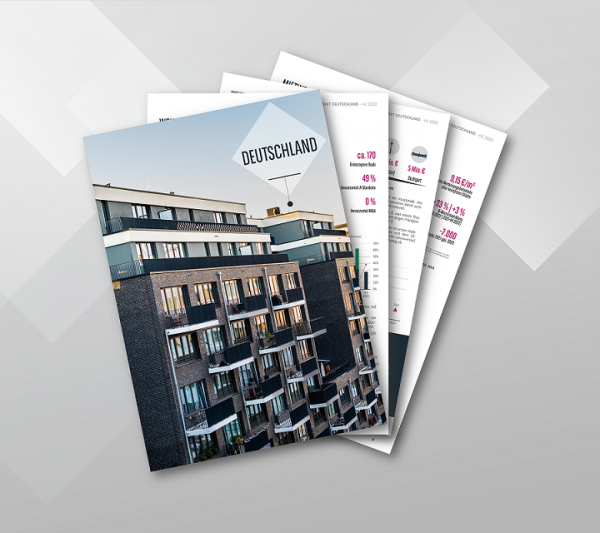
CONTENTS AT A GLANCE

  • Prologue [»]
  • Residential investment market Germany 
  • Rental housing market Germany
  • Market data on major German cities
  • Factsheets on 109 cities
Overview | Prologue| Residential investment market | Rental housing market | Download
 

PROLOGUE


  • Today, the majority of offers on the housing market are listed on online portals. This is typically the place to go to find out what is moving on the market. Listing data is by far the most common and comprehensive source of information when it comes to identifying pricing trends. Looking at this data is like taking the market's daily pulse, quickly available, easily comparable and meaningful at an early stage, at least in terms of trends. However, another factor to be considered when looking at the housing market is that an offer does not guarantee a contract signing and the listed price initially reflects the seller's target. The information on rental units provide on these portals is typically quite accurate. Due to the tremendous excess demand in most conurbations, properties tend to actually be let at asking rents. The situation around purchasing condominiums was similar in many locations during the long period of the zero interest rate environment. Money was cheap, financing was readily available and it was often a seller's market. The environment, however, has shifted noticeably since the interest rate reversal. Buyers are stricter in their calculations and negotiation has returned, raising the crucial question as to whether the prices being asked still reflect actual purchase prices as reliably as they used to.

  • To find out, we systematically compared listing and transaction data for this year's report. We based on our comparison on special assessments conducted by the local valuation committees in the major cities of Berlin, Düsseldorf, Frankfurt, Hamburg, Cologne and Stuttgart. The survey looks at first-time sales of new-build condominiums featuring 40 sqm to 120 sqm of living space. We classified condominiums as new-builds if they were built no more than three years prior to the respective year of sale. We evaluated the trend in number of listings and sales as well as the median values of the asking and transaction prices.


SIGNIFICANT DROP IN TRANSACTIONS SINCE 2021

  • The number of units listed and deals signed has been trending downward overall since 2016. The number of listings reached a low in 2022 (5,780) but has since stabilised and been rising moderately again since 2023, with the number of listings remaining significantly lower than previously. This is likely due to the drop in demand for condominiums in the wake of a weakening economy and significantly more expensive financing costs, which has made it more difficult to sell. It is highly likely that new-build units that would have have been snapped up off-market prior to 2022 will now need to be listed for any success.

  • The steep rise in financing costs has had a particularly noticeable impact on the number of condominium transactions since 2021, which plummeted -69% from 4,730 (2021) to 1,450 (2023) in just two years. Although the number of units sold has risen slightly since then, it remains noticeably below the 10-year average of 4,300 units.


TRANSACTION PRICES WITH STRONGER DEVIATION FROM ASKING PRICES SINCE 2022

  • A comparison of average median values of asking and transaction prices in tier-1 cities through 2021 (unweighted, excluding Munich) shows that asking prices only deviate between -1% and +1% with little difference to transaction prices. This low delta particularly shows the limited room for negotiation that buyers experienced during the strong market phase that lasted through 2021. It also generally reflects the very close approximation that asking prices offer in times of high demand.

  • The peak reached in 2022 to some extent put an end to this close approximation between asking and transaction prices. Since 2022, the average median transaction price has posted between -3% and   -5% per year below the average median asking price.

  • On the one hand, this larger discrepancy shows that sellers were no longer able to realise their asking prices as of 2022 onwards and that buyers again have some room for negotiation and have been able to close at lower prices. The long-term trend, on the other hand, reflects a less pronounced drop in asking prices since 2022. The drop in actual transaction prices, however, is much more tangible.


TRANSACTION PRICES DEVIATE MORE STRONGLY FROM ASKING PRICES, ESPECIALLY IN BERLIN

  • The deviation between median asking prices and median transaction prices is generally low on average in a long-term analysis of tier-1 cities. The discrepancy between the different cities varies considerably, however. While the average for Frankfurt, Cologne and Stuttgart over the past 10 years only comes to around 1%-2%, the delta in Berlin (+7%), Düsseldorf (+4%) and Hamburg (-5%) is much higher. This is likely due in part to the fact that many new market participants with high price expectations entered the Berlin market, a market that had long been underpriced, during the boom years from the mid-2010s onwards. Lower average transaction prices compared to asking prices are a reflection of what in some cases were inflated price expectations. In contrast, the Hamburg condominium market was characterised by persistent excess demand until 2022. Due to the generally high number of prospective buyers, it was not uncommon to see prices negotiated upwards and interested buyers putting down money to reserve properties, which resulted in transaction prices that were often higher than the initial asking price.

  • In 2025, transaction prices in most cities deviated somewhat more heavily than the relevant average. While median asking prices in Frankfurt, Hamburg and Cologne are currently posting a slight 2% higher than transaction prices, the discrepancy in Berlin is striking. Condominiums in the German capital are currently being listed at +17.8% above actual transaction prices, which reflects seller hopes that they will be able to realise significantly higher sales prices. This indicates that the correction phase in Berlin continues.

  • The trend in Stuttgart is moving in the opposite direction with average transaction prices -4.4% below average asking prices, an unusual constellation. Due to the comparatively low number of residential units sold in Stuttgart in 2025 (less than 100), this figure is only reliable to a limited extent.


DÜSSELDORF, COLOGNE AND STUTTGART REACH NEW HIGHS IN 2025

  • Germany's condominium markets were characterised by high price momentum with a clear upward trend in the years leading up to 2021/2022, in which they reached their peak. Accelerated inflation following the outbreak of the war in Ukraine led to key interest rate adjustments and a steep rise in financing costs, which in turn resulted in extensive price corrections in the condominium market across the board.

  • However, the extent of recovery in new-build condominium prices in the country's six top locations surveyed has varied over the past two years. Although the median condominium price in Berlin in 2025 remained around 6% below the 2022 peak, the delta in Frankfurt is somewhat larger at -8%. While prices in Hamburg almost returned in 2025 to the highs seen in 2021, the situation in Düsseldorf, Cologne and especially Stuttgart paints an entirely different picture with all three top locations posting new highs in 2025. Stuttgart is even posting prices 6% above 2021 levels.  

  • In 2025, Stuttgart recorded the highest median transaction prices for new-build condominiums at €8,470/sqm, ahead of Hamburg (€8,070/sqm) and followed at some distance by Frankfurt (€7,400/sqm) and Düsseldorf (€7,340/sqm).

  • Although the price consolidation phase in most of Germany's top cities is coming to an end, it should be kept in mind that this price recovery has largely been accompanied by high construction cost inflation (+14% between Q1 2022 and Q3 2025) over the past four years.


Find out more about current (rent) prices in Berlin, FrankfurtHamburg and Munich and and the price trend at a district level in our new District Dashboards. Click here for detailed rent and price comparisons:

KEY TAKEAWAYS

  1. Residential transaction volume posted €8.9bn in 2025. Although this result is in line with that of 2024, considerably fewer high-volume deals were signed with a significantly larger share of deals ranging between €25m and €100m. This indicates that the market is on much more stable footing and no longer highly dependent on individual high-volume deals in connection with one-off situations as in previous years. At the same time, investors also appear to be targeting investment opportunities outside Germany's tier-1 cities.
  2. The rental market continues to see steep rental growth, particularly in terms of a short to medium-term horizon. Three top locations, Hamburg, Düsseldorf and Stuttgart, posted double-digit growth rates in asking rents over the past 12 months in the new-build segment. Ongoing excess demand in the country's major cities, persistently high construction costs and low completion rates appear to be the main reasons for this upward pressure on rents.
  3. The condominium market entered a repricing and consolidation phase in 2021/2022 in the wake of years of high price momentum as a result of a sharp, rapid rise in financing costs. An analysis of transaction price trends for new-build condominiums based on special assessments by local valuation committees reveals an overall discrepancy between asking prices and purchase prices actually realised since 2022. In contrast to asking rents, sellers are no longer able to set prices at their own discretion in the current market phase.
  4. The number of new condominiums offered and sold reflected a downward trend between 2016 and 2021, with the number of offers down -36% and the number of residential units sold dropping -41%. Although the number of condominiums listed stabilised with the start of the consolidation phase in 2021/2022, the frequency of new-build units actually being sold fell significantly (-69%) between 2021 and 2023.

Download

Would you like to read the entire Residential Report? Please register using our form. We will then send you the entire Residential Report by e-mail.

Bitte füllen Sie das Pflichtfeld aus.
(*) Required field

you can access our privacy policy here: https://www.realestate.bnpparibas.de/en/privacy-policy
 

This report, including all parts thereof, is protected by copyright. In individual cases, it may not be exploited without the written consent of BNP Paribas Real Estate GmbH. This applies in particular to duplications, adaptations, translations, microfilming and storage and processing in electronic systems.

The statements, information and forecasts made by us represent our assessment at the time this report was prepared and are subject to change without notice. The data has been obtained from various sources that we believe to be reliable, but we do not guarantee its accuracy or correctness. This report explicitly does not constitute a recommendation or basis for investment or leasing/renting decisions. BNP Paribas Real Estate assumes no guarantee and no liability for the information contained and statements made.

Publisher and copyright:
BNP Paribas Real Estate GmbH | Editing: BNP Paribas Real Estate Consult GmbH | Date: March 2025